
An ISA is a wrapper, and the point of a wrapper is that what grows inside it isn’t taxed. From 6 April 2027 there is one exception, and it lands on the most ordinary thing an investment account can hold.
Cash.
Leave cash sitting in a stocks and shares ISA and, from that date, the interest it earns is taxed at 22%. The government’s factsheet on the 2027 ISA rules calls it “a flat rate charge”, and it applies to any non-cash ISA, so Innovative Finance ISAs are caught on the same terms.
Nothing lands on your desk. The platform works the charge out, deducts it, and pays HMRC directly, so there is no tax return line and nothing to declare. The interest that reaches your account is already net of it.
One caveat before the numbers. As at 31 August 2026 the rate and the principle are settled policy, but the legislation itself has not been laid: HMRC is still consulting the industry on the draft, and the regulations are expected in the autumn. The detail of how it operates can still move.
Why the charge exists at all
It is an anti-circumvention measure, and the thing it exists to prevent is easy to see. On the same date, the cash ISA allowance drops to £12,000 for under-65s while the overall ISA allowance stays at £20,000. Without something to stop it, the remaining £8,000 could sit as uninvested cash in a stocks and shares ISA and carry on earning interest tax-free, which would leave the new cap doing very little.
Martin Lewis, quoted in MoneySavingExpert’s June 2026 report on the reform, called the fix “a very blunt tool”.
Where the 22% comes from
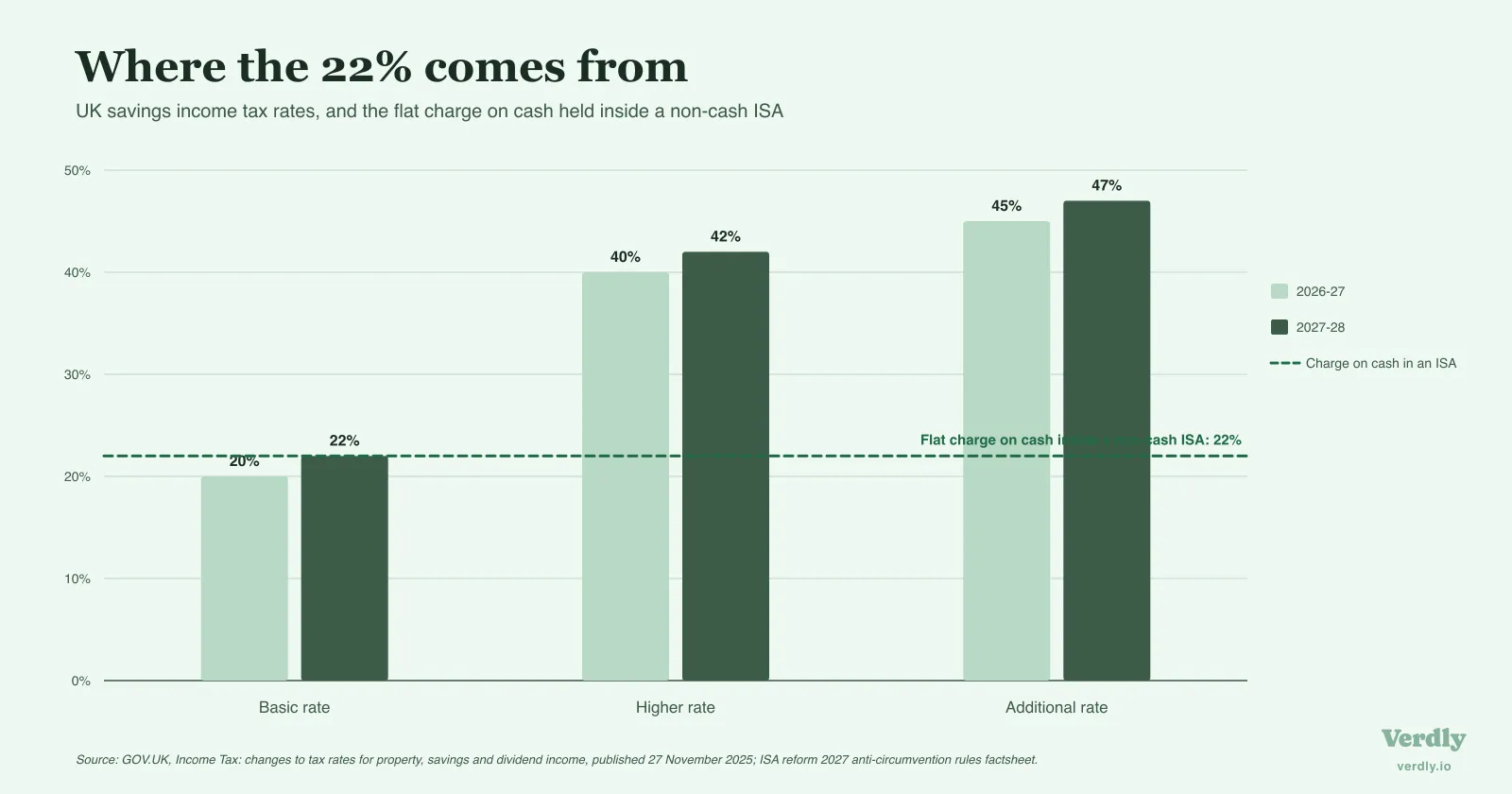
The figure looks arbitrary until you set it beside the other thing changing on that date. From 6 April 2027, tax rates on savings income rise by two percentage points: basic to 22%, higher to 42%, additional to 47%.
So 22% is the new basic rate on savings interest, applied inside the wrapper.
The same interest, inside and out
Verdly publishes for education, not financial advice. What follows describes how a tax rule works, not a view on where anyone’s cash belongs; a regulated adviser is the person for that.
Outside an ISA, most people pay nothing on the first slice of their interest. The personal savings allowance covers £1,000 of interest for a basic-rate taxpayer, £500 for a higher-rate taxpayer, and nothing for an additional-rate taxpayer. Lower earners can have up to £5,000 more covered by the starting rate for savings, which tapers away and is gone once other income reaches £17,570.
Inside an ISA, none of that applies. The allowance covers interest earned in ordinary savings; it does not reach inside a wrapper. The factsheet is explicit: “The Personal Savings Allowance does not apply to any growth or interest paid in an ISA.”
That combination gives the tax on cash in a stocks and shares ISA an unusual shape.
| Tax band | Personal savings allowance | Interest within the allowance | Interest above it | Cash interest inside a stocks and shares ISA |
|---|---|---|---|---|
| Basic rate | £1,000 | 0% | 22% | 22% |
| Higher rate | £500 | 0% | 42% | 22% |
| Additional rate | None | n/a | 47% | 22% |
Start with the basic-rate row, above the allowance. 22% either way. For that taxpayer the wrapper makes no difference to cash at all, and that is the policy working exactly as designed: it removes the reason to park cash in an investment ISA by making both sides of the wrapper identical.
The higher and additional rate rows still favour the wrapper, and by a wide margin: 22% against 42% and 47%, a saving of 20 and 25 points.
The column that catches people is the first one. Interest covered by the personal savings allowance is taxed at nothing outside an ISA, and from April 2027 it carries the full 22% inside one.
Percentages are easy to skim past, so here it is in pounds: £1,000 of interest, taxed three ways.
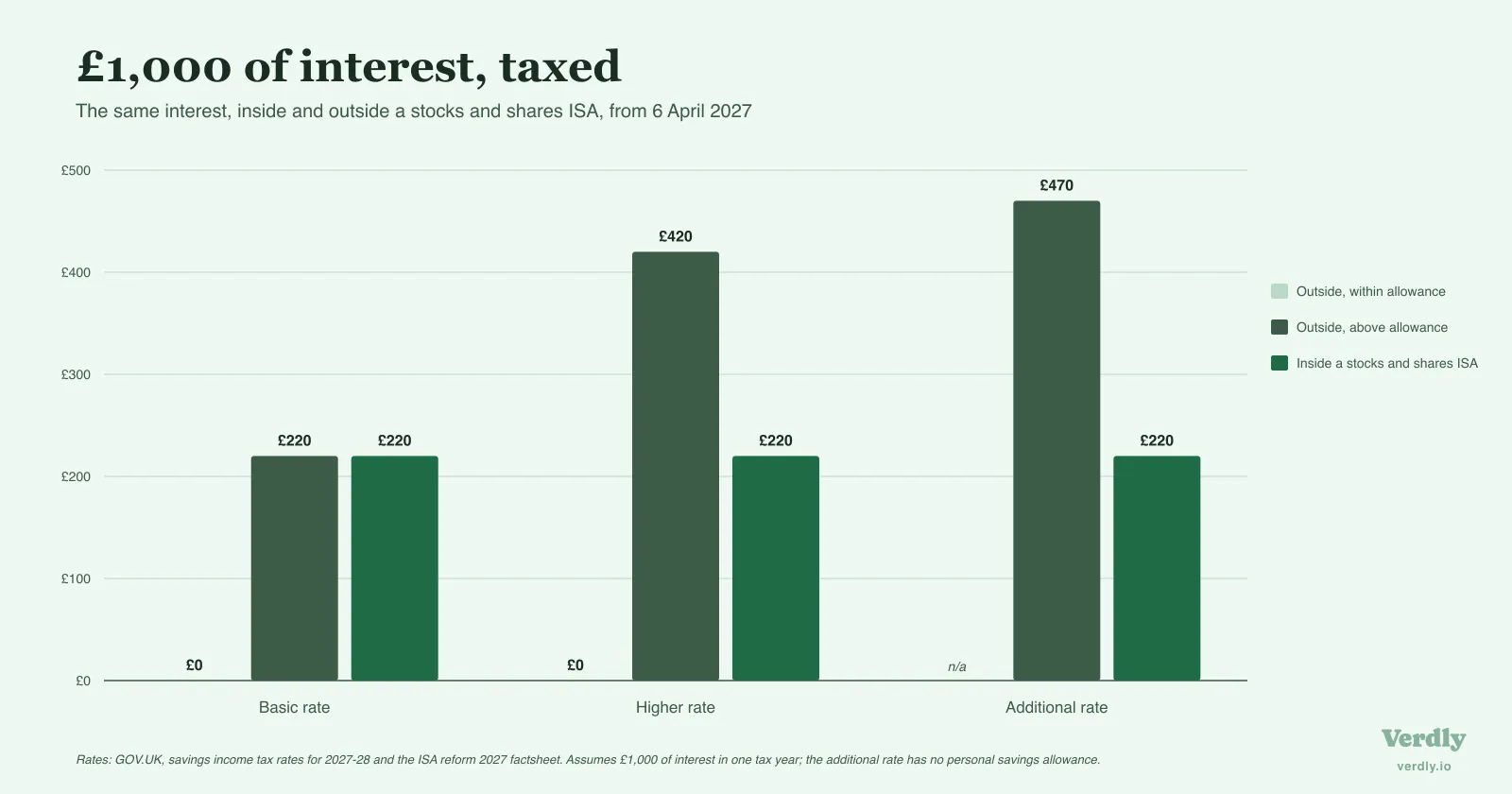
The starkest case is the basic-rate taxpayer with allowance to spare: the same £1,000 costs nothing in a savings account and £220 inside the ISA. At the other end, an additional-rate taxpayer pays £470 outside and £220 inside, so the wrapper saves them £250. The higher the rate you pay outside it, the more the wrapper is worth, and the allowances are what turn that around at the bottom end.
Craig Rickman of interactive investor named the oddity early, in the company’s analysis of the reforms: “you could have a scenario where you’re paying tax in the tax wrapper and you’re not paying tax outside the tax wrapper.”
Which raises the question of who is holding cash in an investment ISA in the first place. Usually not by intention: money from a sale that has not been reinvested yet, dividends accumulating before they are swept up, a monthly contribution that landed before the buy order went through, or a deliberate pause while markets are unsettled. Most of it is cash in transit rather than cash parked, and the charge does not distinguish between the two.
Money market funds are a different rule
Most coverage runs two rules together here, and they do separate jobs.
The 22% charge is one. The other decides what counts as an investment at all. From April 2027 only money market funds are treated as cash-like. They can still sit inside a stocks and shares ISA, but they cannot be the whole of it, and an account holding nothing else stops qualifying.
So a money market fund escapes the 22% charge, while a portfolio made up entirely of them stops being an ISA investment. Everything most people actually hold is untouched: shares, funds, investment trusts, ETFs, corporate bonds and gilts all sit outside the cash-like definition.
There is a record-keeping consequence in this. “What’s in the ISA” becomes two numbers rather than one, because the cash and the investments are now taxed on different terms. Keeping them separable rather than summed is the sort of thing organising your holdings and categories is for, and Verdly tracks them as distinct lines.
Where this leaves the balance
None of it alters what the cash is worth. A balance is a balance, and it lands in what your net worth measures at face value whether it sits inside a wrapper or beside one.
What changes is narrower and stranger. For thirty years an ISA has meant one thing: whatever is inside is yours, untaxed. From April 2027 that sentence carries a footnote, and the footnote is about cash.