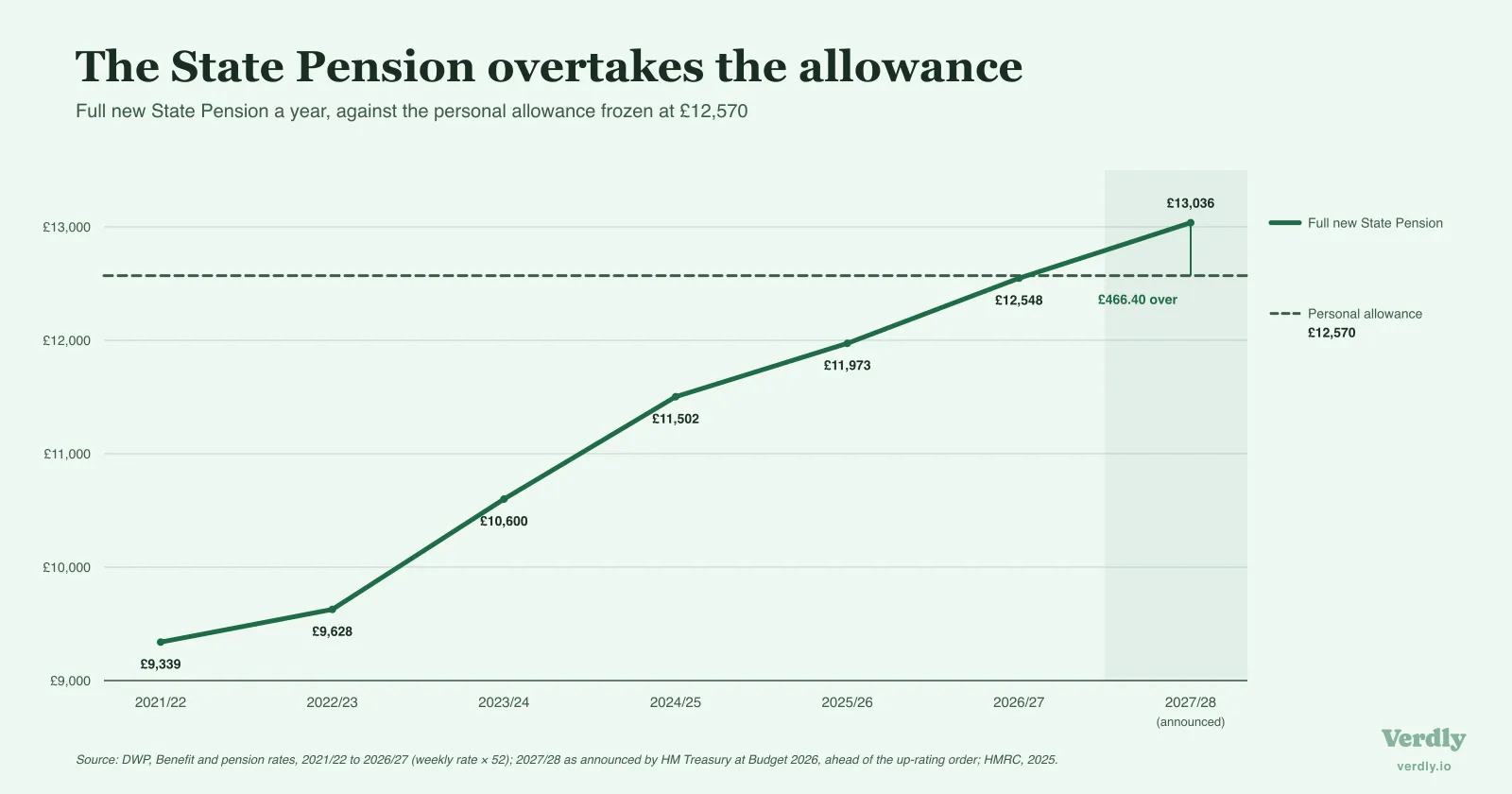
The full new State Pension this tax year is £241.30 a week, or £12,547.60 a year. The personal allowance, the income most people can receive before income tax starts, is £12,570. Those two numbers sit £22.40 apart, and that small margin is the only reason someone living on the full new State Pension alone pays no income tax on it.
From 6 April 2027 the full new State Pension is set to move past the allowance, and the rest of the State Pension tax question follows from that crossing.
Two numbers heading in different directions
The State Pension has always been taxable income. It’s paid without tax taken off and uses up the personal allowance first.
What has changed is the allowance. It has been held at £12,570 since 2021, and HMRC has set out that it stays at that level until 5 April 2031. The State Pension rises every April. For 2027/28 the full new State Pension is £13,036.40 a year, according to the Treasury’s Pension Tax Allowance explainer, which says it “will rise above the Personal Allowance”.
The gap is £466.40. At the 20% basic rate, that is £93.28 of income tax a year on the State Pension alone. Without a fix, that would mean small tax bills for people with no other income, usually collected through a Simple Assessment.
What the Pension Tax Allowance does
The fix was announced at Budget 2025 and set out in detail at Budget 2026. Anyone over State Pension age, or reaching it during the tax year, whose total income is no more than the full new State Pension gets a reduction in their income tax worth up to 20% of the gap between the State Pension and the personal allowance. For 2027/28 that is £93.28, which is exactly the bill described above, so it goes to nothing.
The details, all from the explainer:
- It’s a reduction applied to the tax bill, and the personal allowance itself stays at £12,570.
- HMRC applies it automatically from its own records. Nobody claims it, and receiving the State Pension isn’t a condition.
- It can’t be passed to a partner, and it never produces a refund.
- Scottish taxpayers get the same amount, worked out at the 20% basic rate rather than the Scottish starter rate.
- It runs for three tax years, 2027/28 to 2029/30, rising each year with the State Pension.
The Treasury estimates around 500,000 pensioners in total will pay less income tax in 2027/28 because of it, including around 290,000 who will pay none.
As at 30 October 2026 the legislation, due in the Finance Bill 2026-27, hasn’t been published, so the detail here comes from the Treasury’s explainer and HMRC’s tax information and impact note.
The taper, and a 53% band
Above the full State Pension, the allowance shrinks by £1 for every £3 of extra income, and it’s gone entirely at £13,319. The Treasury publishes the band as running from £13,037 to £13,319, so it’s only about £280 wide.
Inside it, each extra pound of taxable income costs 20p in ordinary income tax plus 33p of lost allowance. That’s an effective rate of about 53% on a slice of income most people would assume was taxed at 20%. Interest covered by the savings allowances still costs the 33p, just without the 20p.
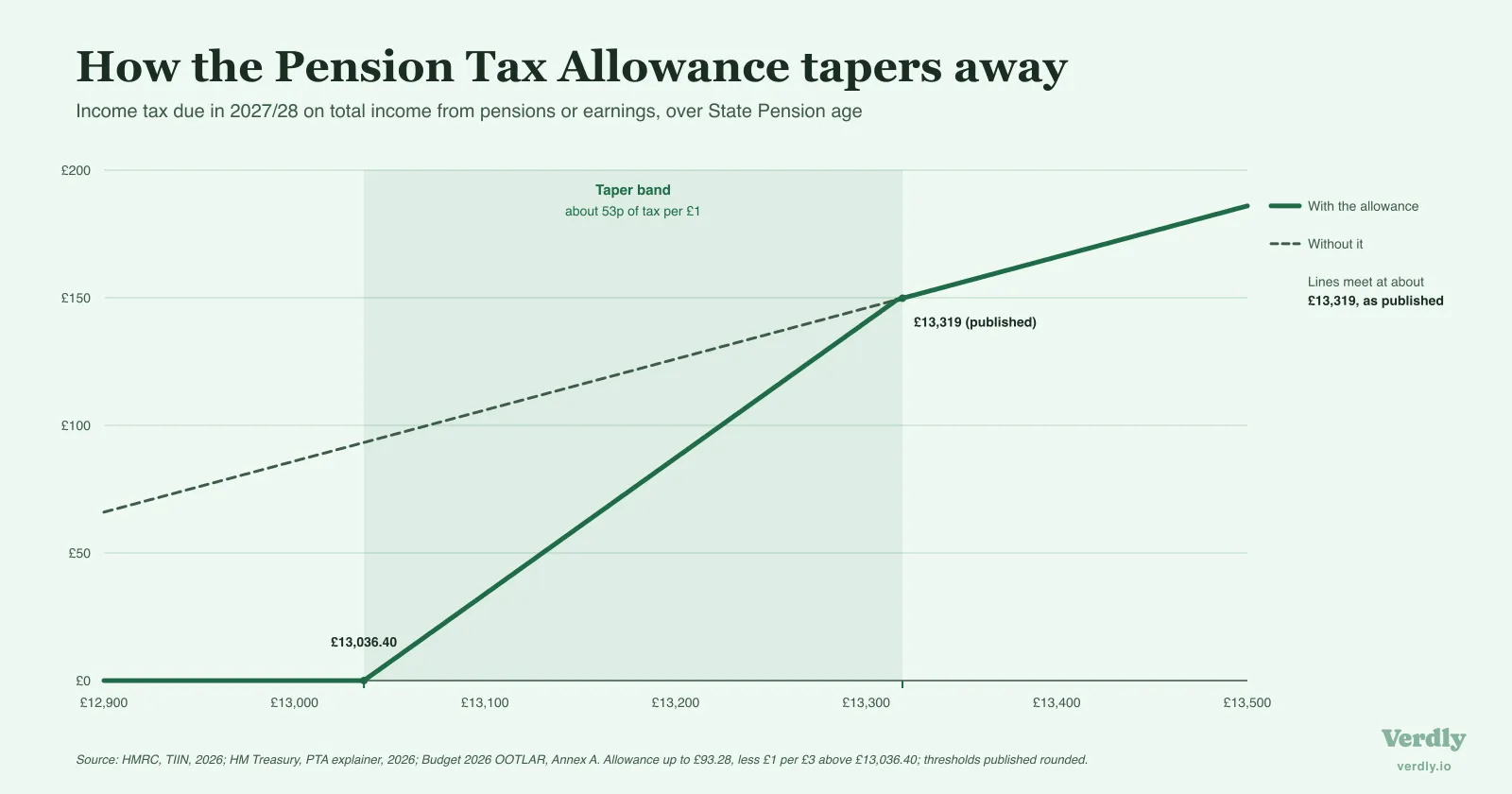
So the headline that pensioners on the State Pension won’t pay tax describes only people whose income is almost entirely the State Pension. A workplace pension paying more than about £280 a year puts someone past the end of the taper, and the State Pension’s £466.40 over the allowance is taxed as usual.
Where savings sit changes the answer
The test is built on total income, and the explainer is specific about what counts. Income generated within an ISA “does not count towards your total income”. Interest earned in an ordinary savings account does count, including interest already covered by the starting rate for savings or the personal savings allowance, where no tax is due on it at all.
Verdly publishes for education, not financial advice. Your circumstances will differ, so speak to a regulated adviser for decisions specific to you.
Let’s put two people side by side for 2027/28. Each has the full new State Pension and no other pension. Each has £7,100 of savings earning 4%, which is £284 of interest a year.
| Savings in an ordinary account | Savings in a cash ISA | |
|---|---|---|
| State Pension | £13,036.40 | £13,036.40 |
| Interest | £284 | £284 |
| Total income for the test | £13,320.40 | £13,036.40 |
| Pension Tax Allowance | £0 | £93.28 |
| Income tax due | £93.28 | £0 |
The interest itself is untaxed in both columns. In the first it still counts as income, which takes the total past £13,319 and removes the allowance, so the £93.28 that results is tax on the State Pension. Smaller balances land part way along the taper: £3,000 at the same rate earns £120 and leaves about £40 of tax to pay.
That’s a description of how the rule is built. Access, interest rates and the rest of a person’s income all bear on where savings are held, usually by far more than £93 a year. The same split between inside and outside the wrapper runs much wider at higher incomes, which is what the wrapper is worth over a decade works through at the April 2027 savings rates.
Why it matters before retirement
For anyone still building towards retirement, the allowance is the short-lived part. It ends on 5 April 2030, a year before the personal allowance freeze does, and the explainer says only that what follows will be looked at “in the usual way”. Nothing for 2030/31 has been announced.
The durable part is the crossing. Once the full new State Pension sits above the allowance, private pension income in retirement is taxed from its first pound, and part of the State Pension itself is taxed too unless an allowance like this one is in place. That changes the after-tax income a retirement plan produces and leaves the balance sheet alone. The State Pension never sits on that sheet, a point covered in why the State Pension sits outside your net worth. It becomes a line in the income model, next to projecting how your own figures move.
£13,036.40 and £12,570 now point in different directions, and any retirement income modelled from today has to carry both. The savings side of that model is the record Verdly keeps, snapshot by snapshot.