


The first row is easy. Current account, log in, copy the balance across. The second and third go the same way.
Then you reach the pension, and stop.
Between deciding to track your net worth and having a figure worth tracking sits a job nobody writes about: finding a defensible number for every single thing you own. Some of those numbers are waiting in an app. Some arrive once a year and are already out of date by the time they land. A few don’t exist at all, which is a property of the asset rather than a gap in your record-keeping.
Verdly publishes for education, not financial advice. Your circumstances will differ, and a regulated adviser is the right person for decisions specific to you.
Three kinds of number
Every line on a net worth record is one of three things, and most of this job is knowing which one you’re looking at.
Some figures are exact. Your current account holds what it holds, and you and the bank agree to the penny.
Some are reported. Somebody else works them out and tells you: a pension provider, a broker, a lender. They’re accurate as at a date, and that date is almost never today.
The rest are estimated. There is no authority to ask about a house or a car, only competing methods that disagree with each other, so the figure you write down is really the name of the method you picked.
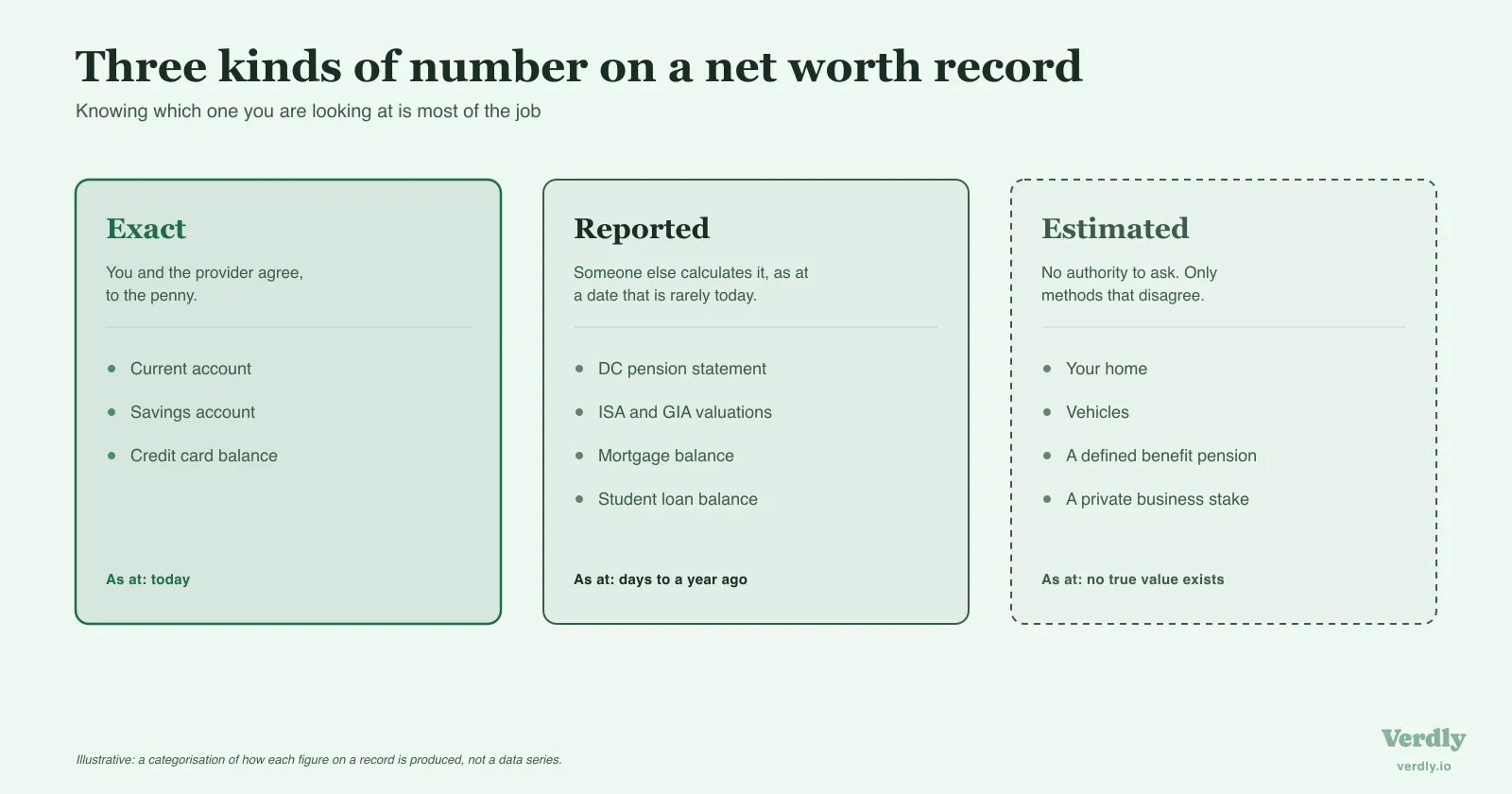
What counts as an asset or a debt is the easier question. Where each number comes from is what decides how much the total is worth knowing, and mixing the three kinds without noticing is what makes a record look more precise than it is.
The figures that are simply true
Current accounts, savings accounts and credit cards resolve to a number you can read off a screen, and the only real decision is which screen.
Card balances come in two flavours. The statement balance is a snapshot taken on your billing date. The live balance includes everything you’ve spent since, and the two can differ by a month of spending. Neither is wrong. Picking one and holding it every month is what matters, because a record that alternates between them invents movement that never happened.
Pending transactions have the same shape. If your bank shows an available balance and a cleared balance, they’ll disagree by whatever hasn’t settled yet. Same rule: choose, and don’t drift.
The figures somebody else reports to you
This is where most of the work sits, and where dates start to matter.
A defined contribution pension gives you two numbers, and both are correct. Your annual benefit statement is a snapshot at the scheme year end, and since October 2022 workplace schemes used for automatic enrolment have had to fit it onto one double-sided sheet of A4 under DWP statutory guidance. The provider’s portal usually shows a more recent valuation of the same pot. The statement is the one that arrives; the portal is the one that’s current.
Investments in an ISA or a general investment account are priced at the last close rather than live, and funds typically price once a day. A valuation taken at nine in the morning and one taken at four in the afternoon can be the same number.
A mortgage has a balance and a redemption figure, and they aren’t the same thing. Under the FCA’s mortgage conduct rules a lender has to send you a statement at least once a year, and separately can produce a redemption statement showing what it would cost to clear the loan, including charges that only apply on early repayment. For a net worth record the outstanding balance is the number you want. The redemption figure answers a different question, and it’s usually the larger of the two.
A student loan balance sits in your online account. It used to be a genuinely stale number, updated once a year when HMRC passed on your PAYE deductions. Since April 2019 HMRC has sent repayment information more frequently through the tax year, so the balance is far closer to current than it was, though still not live. Whether that balance is the right thing to record at all is its own argument.
The figures nobody can give you
Then there’s the house, which is usually the largest line and the only one with no correct answer.
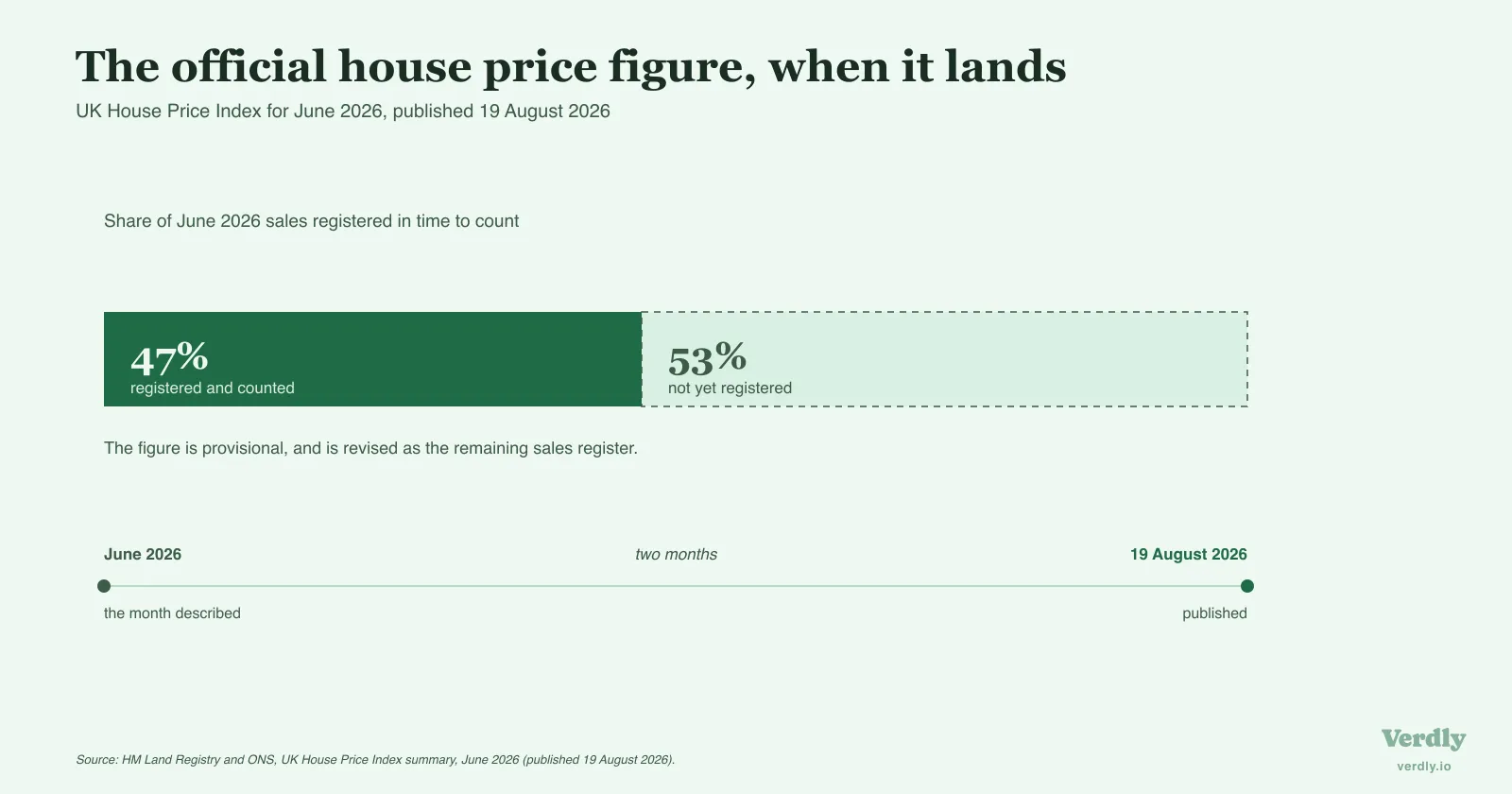
The official measure is the UK House Price Index, and how it’s built is instructive. The June 2026 release put the UK average at £272,000, up 2.0% on the year. It was published on 19 August, two months after the month it describes. It’s provisional, it’s built only from sales registered so far, and for June that came to around 47% of the sales HMRC estimates actually took place.
So the most authoritative house price figure in the country is an area average, two months old, drawn from under half the transactions, and subject to revision. It is a good index, and it was never built to value an individual house.
That leaves three honest options, none of them a fact: what you last paid, moved by the index for your area since; an estate agent’s appraisal; or an automated estimate from a property portal. Each is defensible. The trouble comes from switching between them without saying so, because a change of method shows up in your record as a change in your wealth.
Cars work the same way, with trade guides standing in for the index. A defined benefit pension is the hardest case of the lot, and the ONS has rebuilt its own method for it more than once. Anything jointly owned raises a question about whose figure this is before it raises a valuation one. A stake in a private business may have no method available to you at all.
For every one of these, the useful habit is a small one: write down which method produced the number, next to the number. Future you won’t remember, and the method is the thing that has to stay constant.
Making this month’s figure comparable to next month’s
A single snapshot is only an inventory. Turning it into the run of figures you actually wanted is a question of comparability.
Three habits do most of that work. Attach the date you’re recording as at, rather than the date you happened to sit down. Hold one convention on the questions that have two answers, individual or household, gross or net of anything, and keep holding it. And keep the method note beside every estimated figure.
None of that survives if the method note has nowhere to live. A column, a field, a line in the margin: the only requirement is that it sits with the figure and travels with it, because the layout you choose decides what you can still ask of the record in five years.
A purpose-built net worth tracker gives the note a home by default, and holding each account on its own line keeps the estimated figures visibly separate from the exact ones.
What the first one is for
Your first snapshot has nothing to compare itself to. That’s the honest state of it, and worth saying, because the number on its own tends to underwhelm.
What it does give you is the inventory, and that is the part people underestimate. Sitting down to find a figure for everything is how most people turn up the pension from a job they left in 2017, or the savings account holding more than they remembered, or a card balance nobody had looked at in a while. None of that shows up in a total, but all of it shows up in the work of building one.
The trend starts next time. How often to take the next one has a better answer than most guides give it, and it’s a question you only get to have once the first row is filled in.
Last reviewed 25 August 2026.