


Ask the internet whether your car is an asset or a liability and you’ll get a fight. One camp says a car costs you money every month, so it’s a liability. The other says you own it and could sell it tomorrow, so it’s an asset. Both are answering a real question. They’re just answering two different ones.
For net worth, the answer is settled and a little boring: a car you own is an asset, and it belongs in the total at what it’s worth today. The interesting part is everything the “asset or liability” row talks past: how to value something that’s losing money as you read this, and what to do when the car is half yours and half the finance company’s.
Verdly publishes for education, not financial advice; speak to a regulated adviser for decisions specific to your situation.
Two questions hiding in one argument
A car you own outright is something you could sell for cash, and that is the only test net worth applies. So it’s an asset, full stop. Whether buying it was a smart use of money is a completely separate question, and it’s the one the “liability” camp is really answering. Both things can be true at once: your car is an asset on your balance sheet and a poor long-term place to park money. Net worth only cares about the first bit. It’s a photograph of what you own minus what you owe, and something you could sell for a few thousand pounds counts whether or not it was a bargain.
So it goes in.
Running costs stay out, though. Fuel, insurance, road tax, the MOT, servicing and repair bills are what the car costs to use, not what it’s worth to sell. They decide whether the car was a good idea, and over its life they can add up to more than the car itself. But they’re outgoings, not balance-sheet entries. They don’t change the number you write down for what the car is worth.
Value it at what you’d get, not what you paid
The one figure you should never use is the price on the invoice. A car starts shedding value the moment it leaves the forecourt, and by the time you’re totting up your net worth the sticker price is usually fiction.
To get a current value, the free UK valuation tools do the job: Motorway, Auto Trader and WeBuyAnyCar will all price a car from its registration and mileage. They’ll usually show a few numbers. There’s a private-sale value, roughly what you’d get selling it yourself; a part-exchange value, what a dealer offers against your next car; and a trade value, the lowest of the three. For net worth, the private-sale figure is normally the fairest, because it’s what you could realistically turn the car into if you had to.
Then accept that the number only travels one way. Motoring-industry estimates commonly put a new car’s loss at around half its value over the first three years, with the steepest fall in year one before the decline flattens out. A house can drift up or down with the market. A car, in normal use, heads down and keeps going.
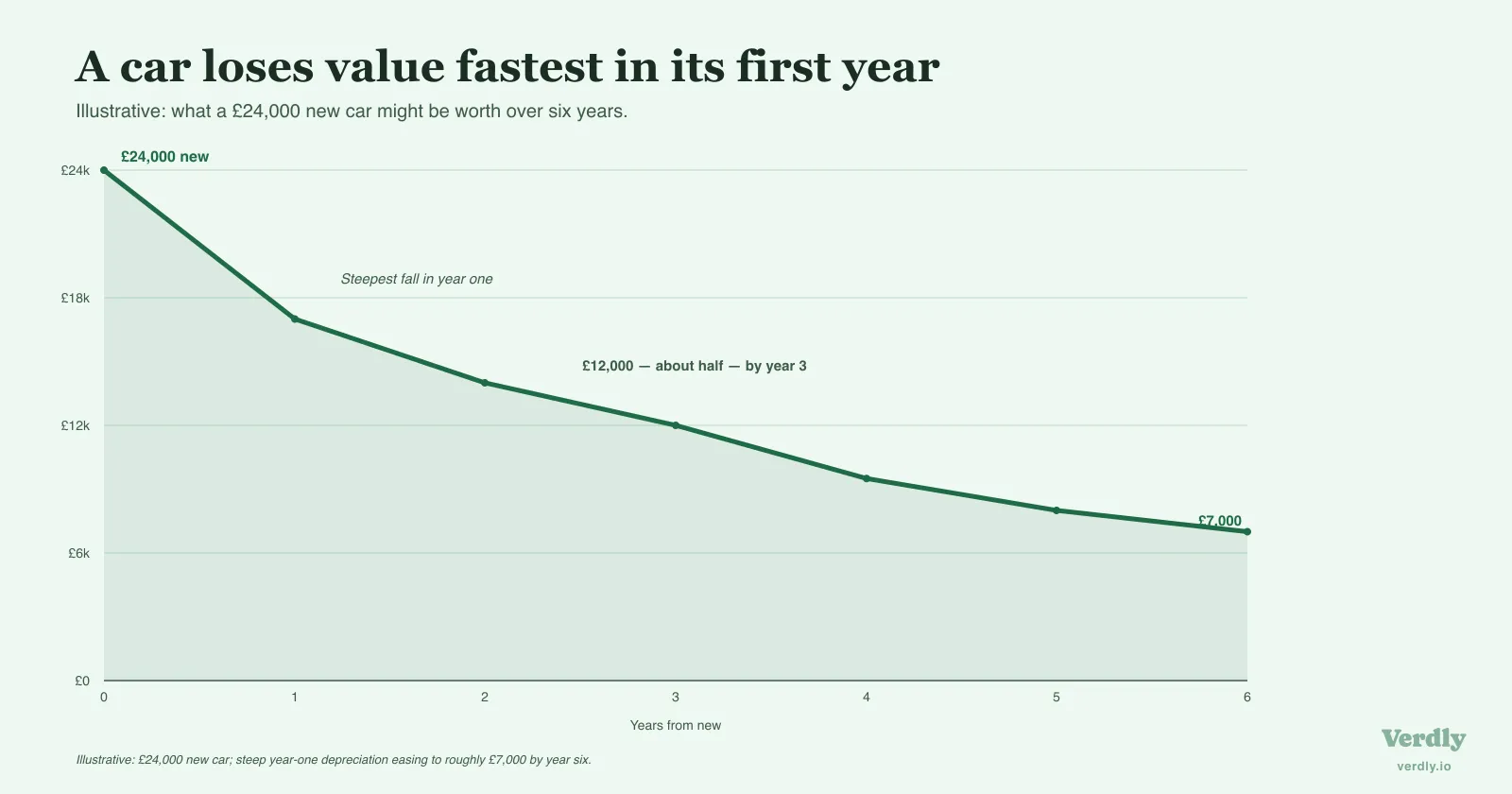
One exception is worth naming. A classic or collectible car, the rare model people increasingly want, can hold its value or even climb, behaving more like an investment than a runaround. It still goes in on the same terms: value it at what it would realistically sell for today, ideally backed by recent sales of similar cars or a specialist valuation, not what you paid or hope it’s worth. The direction of travel is just reversed. For most cars it’s down; for the rare appreciating one, it can be up.
When the car is half yours and half the lender’s
Most new cars on UK driveways aren’t paid for outright, and that changes the sum a little. It all comes down to who actually owns the thing.
On hire purchase (HP) or a personal contract purchase (PCP), you’re buying the car on credit, so treat it as two entries. The car goes in as an asset at its current value, and the outstanding finance balance goes in as a liability. What lands in your net worth is the gap between them. If the car’s worth £11,000 and you still owe £4,000, your share is £7,000. Early in a PCP that gap can be thin, or even negative, when you owe more than the car would fetch.
A personal loan is the simpler cousin, because it isn’t tied to the car. Borrow from your bank to buy the car outright and it’s yours from day one: put the car in at its full current value, and record the loan as its own liability, exactly like any other debt. The two then move on their own clocks, where with HP or PCP the finance is pinned to the car itself.
A lease works differently. On a personal contract hire (PCH) deal, or any straight lease, you never own the car; you’re renting it. Neither the car nor the monthly payments belong on your net worth. It’s a cost of getting around, closer to a train season ticket than to something you own. The same goes for a company car: it’s your employer’s asset, not yours, however nice it is to drive, so it stays off your balance sheet entirely.
Own it, count it. Rent it, don’t.
A car on a real balance sheet
Take someone in their late twenties who bought a car three years ago for £22,000 on a PCP. Today a valuation tool puts its private-sale value at about £11,500, and they’ve got £4,500 left to clear on the finance. Alongside the car they hold £9,000 in a Stocks and Shares ISA and £2,500 in easy-access savings.
The car’s contribution to their net worth is £11,500 minus £4,500, so £7,000. Add the ISA and the savings and their net worth is £18,500. The car is a real chunk of that, more than a third. But here’s the part the invoice hides: written down at the £22,000 they paid, the same car would have overstated their worth by more than ten grand.
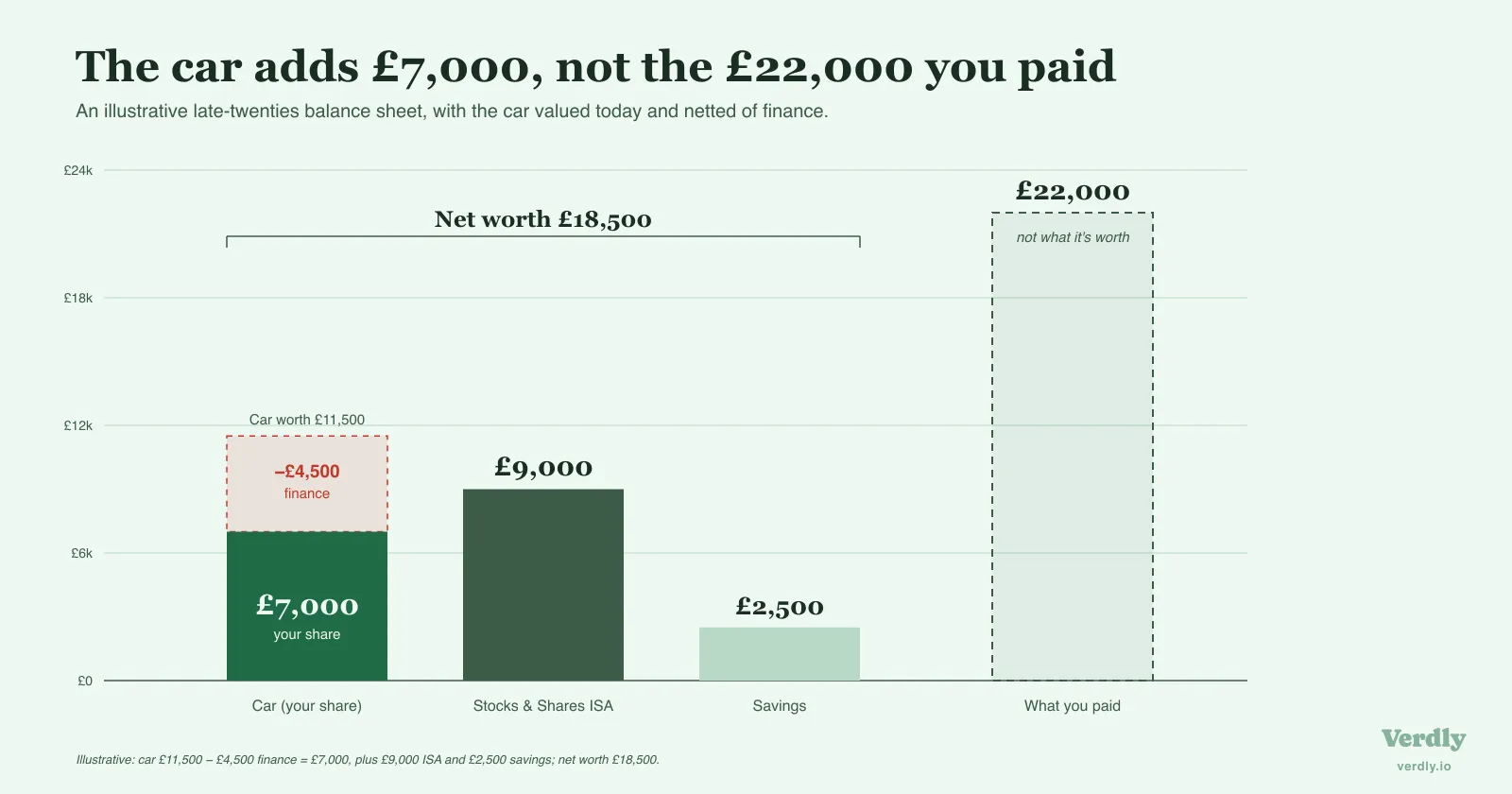
And the car line behaves unlike any other on the page. Leave everything untouched for a year and the ISA might tick up, the savings earn a little interest, and the car loses perhaps another £1,500 on its own. It’s the one asset you hold that’s built to shrink.
Is it even worth tracking?
If the car is a small part of what you own, and revaluing it every month feels like busywork, it probably is. Precision matters least on the lines that matter least. For a car that’s a modest slice of the total, a fair few people just drop in a conservative value and refresh it a couple of times a year rather than chasing the exact figure. The trend of your whole net worth won’t hinge on whether the car is worth £11,200 or £11,500.
It’s worth a little more care in two cases: when the car is a large share of your wealth, or when you’re measuring yourself against national figures. The ONS Wealth and Assets Survey counts vehicles inside what it calls physical wealth, which made up around 10% of total household wealth in Great Britain in April 2020 to March 2022. The published averages already have cars baked in, so if you’re checking how your number stacks up, add everything up the same way and leave your car in to match like with like. It’s not a fringe line, either: more than three in four UK households have access to a car or van, according to the National Travel Survey, so for most people it genuinely belongs on the balance sheet.
The one line that’s meant to shrink
There’s something clarifying about the car once it’s on the page. Most of your net worth is trying to grow: the ISA, the pension, the equity in a home. The car is the honest counterweight, the asset you can watch lose value in real time, which is exactly why it earns its place at what it’s really worth rather than what it once cost. Pretending it’s still worth the invoice price doesn’t make you wealthier. It just makes your net worth less true.
Count it, value it honestly, net off the finance, and let it do the one useful thing it can on a balance sheet: reminding you which of your assets are working for you and which are just along for the ride. It’s the same question that trails every asset you own once you start adding them up, from the home you live in to the pension you can’t touch yet. The fuller answer to what actually counts in your net worth is less about any single line and more about being honest with all of them. If you’d rather keep the car in view without letting it flatter the total, it helps to log it as its own line, with the finance beside it.
Last reviewed 13 July 2026.